
Technical Information
Developer: Thomas Happ Games LLC
Publisher: Thomas Happ Games LLC
Release Date: September 30, 2016
Trace is a dedicated scientist who ends up suffering an accident in a laboratory and wakes up in a completely different world, surrounded by technology and strange creatures.
He doesn’t know for sure whether he’s on another planet, in another civilization, in another dimension, or simply experiencing someone else’s reality.
His mission is to explore this new environment to discover what is really going on.
Final Thoughts – Analyzing the Game as a Whole
For me, the most incredible aspect of this game is the fact that it was made by a single person. Art, code, soundtrack, testing… It’s truly something to tip your hat to.
Graphics and UI
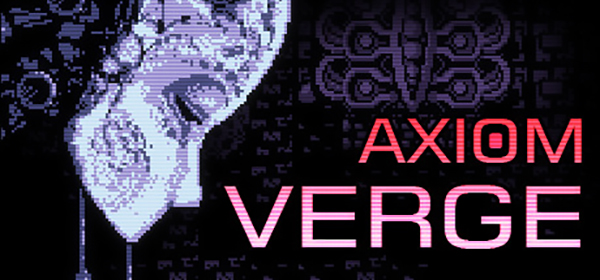
Carefully crafted pixel art, with a design that seems to be influenced by the work of H. R. Giger (the artist who created the Alien artwork).
The environments are very well detailed, with lots of small touches that make a big difference in the player’s experience and immersion.
It’s important to point out that a “bug” concept was adopted in the art style, in which enemies resemble Missingno from Pokémon Red/Blue. This not only fits extremely well with the art style, but also further reinforces the game’s technology-driven concept.
The menus are easy to understand and well localized (I played the game in Brazilian Portuguese).
The HUD is heavily influenced by Super Metroid’s HUD, and the mini-map at the top follows the exact same concept.
There is also a character menu where you can view the map, weapons, ability upgrades, and the texts found during gameplay.
Soundtrack and Sound Effects
Excellent music and sound effects.
The track from Ukkan Na, for example, strongly resembles “Clotho” from the game Columns (the one released for the Mega Drive, which is very similar to Tetris).
In Kur, voices blend into the music, creating a macabre and suspenseful atmosphere.
Each region of the map has its own specific track, which does an excellent job of setting the game’s extraterrestrial tone.
It’s definitely a very memorable soundtrack for me, one I’ll remember even if I go years without touching this game.
Gameplay
The influence that the SNES classic Super Metroid had on the game is very clear.
Smooth gameplay and well-calibrated physics. The maps are well designed, featuring several secret passages. Some areas are true labyrinths, but considering the game is a Metroidvania, it’s completely understandable that the developers want the player to get lost.
My only negative criticism is related to the boss patterns. They are very repetitive, and once you memorize them, the difficulty drops significantly. This is an aspect that could have been better developed, with slightly more complex patterns.
The difficulty increases gradually as you progress through the game. Your strength and health bar increase as you find upgrade items.
There are several weapons to use, each one offering a different strategy. I personally liked the Kilver and the Inertial Pulse the most.
This is a very strong positive point of the game, as the player has the freedom to use whichever weapon suits them best.
After finishing the game, a status screen is displayed, showing total playtime, the percentage of the map and items unlocked, the number of deaths, and the difficulty level.
Replayability and Game Retention
Once you finish the game, you’ll want to play it again to unlock all the items and fully complete the map. There’s also a time attack mode to please more hardcore players (or those obsessed with speedruns).
It’s a very enjoyable game, once you memorize the routes and know what needs to be done, it becomes a fast-paced experience that can even be played casually.