Before Steam: The Little World of ZapSpot Games


One of the periods I remember most fondly was definitely the legacy of games I discovered in the late ’90s and early 2000s. Back then, I had an MMX PC that stayed with me until around 2005.
My dad would always buy those CD-ROM magazines sold at newsstands (they were very popular in Brazil), and thanks to that, I got to know all kinds of PC games, ranging from AAA titles to unbelievably janky ones.
It was very common for demos and indie games (which weren’t even called that at the time) to be distributed through those CDs.
Among the CDs my dad used to buy, the classic “CD-ROM Fácil” (something like Easy CD-ROM) and “Revista do CD-ROM” (CD-ROM Magazine) were part of the collection, and that’s where I discovered some ZapSpot games. These little games left such a strong impression on me that I never forgot the company’s name.
I want to point out that at the time, I had absolutely no idea what ZapSpot actually was, and the brief history I’m sharing today only became possible thanks to the research I did online.
What is ZapSpot?
According to the “About Us” section of the now-defunct website, the ZapSpot Network was a showcase created by P3 Marketing Group, whose mission was to become the leading provider of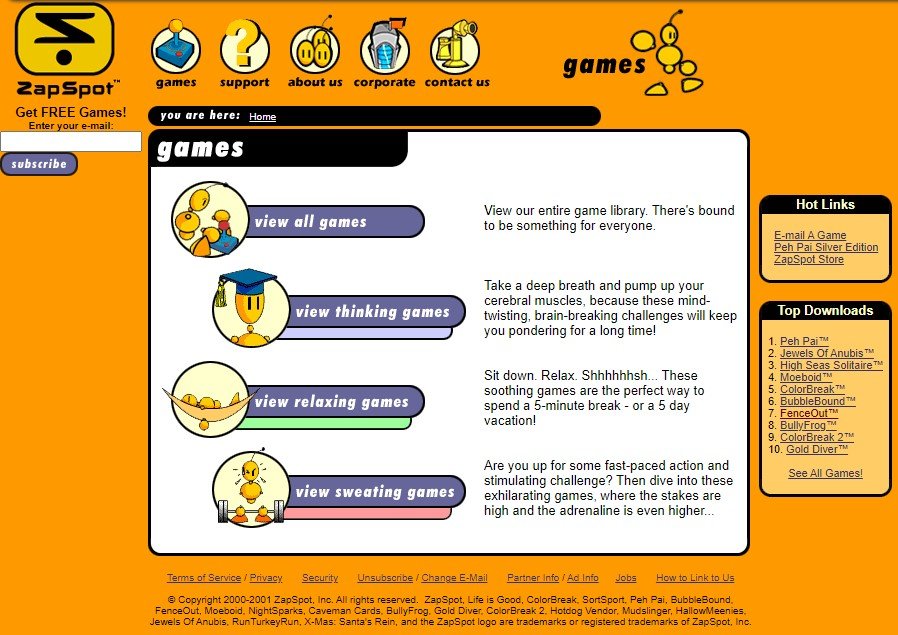 software technologies and services, enabling companies to create dedicated communication channels for their customers through lightweight and interactive software.
So, they essentially created a way for companies to have a presence directly on users’ PCs, in other words, a launcher. Or at least something close to what we would call a launcher today.
P3 Marketing Group was founded in New York by former Microsoft veterans in February 2000.
In the end, that explains why the games were so simple. ZapSpot was basically a walking portfolio meant to demonstrate how a launcher could work. The goal wasn’t exactly to create amazing games, although some of them became unforgettable to me. 🙂
The Games
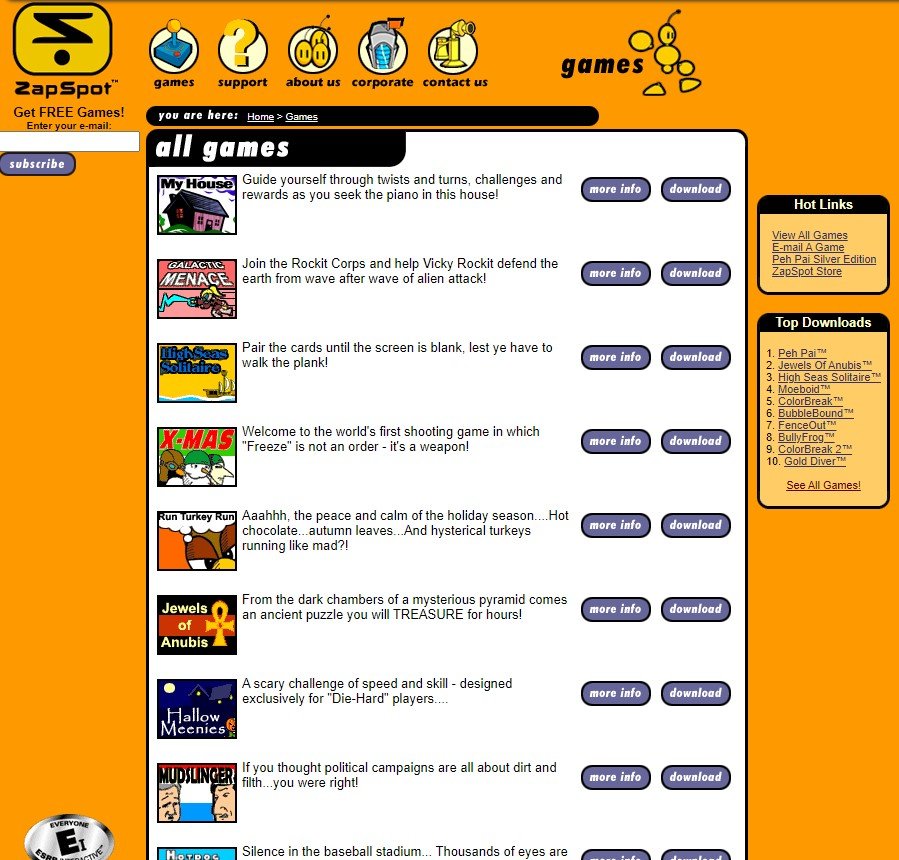 An internet connection wasn’t required to play, but if you had one, it felt like having a super stripped-down version of Steam. The games were easy to pick up and included tutorials.
There was no ending, the objective was simply to rack up points.
At the time, I didn’t get to play every game they released. But out of the ones I tried, my favorites were Run Turkey Run, Jewels of Anubis, and Fence Out (which is basically a reinterpretation of the classic Qix).
Today, the website is no longer online, but it can still be visited through Archive.org. Some of the games are still available for download there as well.
I downloaded a few, and despite being quite old, they ran without any compatibility issues on Windows 11.
To visit the ZapSpot website, click here.