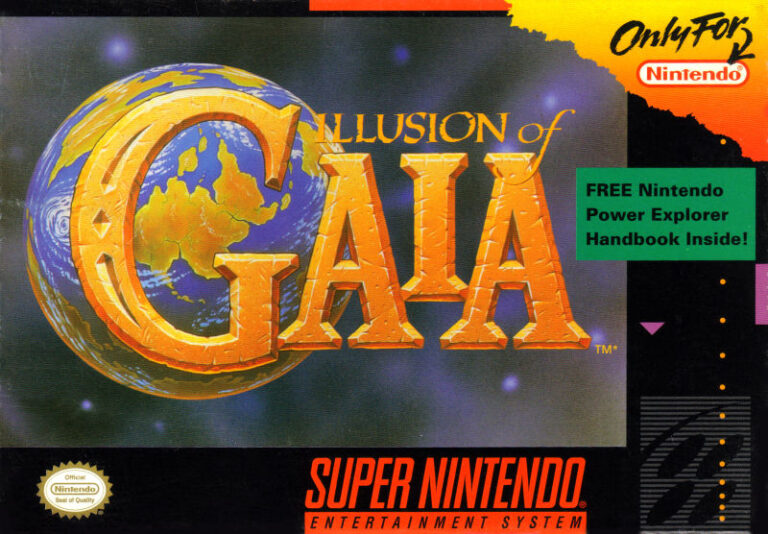
Illusion of Gaia/Illusion of Time (SNES)

Technical Information
Developer: Quintet
Publisher: Enix (Japan) and Nintendo (rest of the world)
Release Date: September 1, 1994
In Europe, the game was released under the name Illusion of Time.
Illusion of Gaia tells the story of a boy named Will, who lost his father during a trip. After that incident, he had a strange encounter with a being called Gaia, who warns him about an impending comet and tells him that he must prevent this from happening.
To prevent this disaster, Will must find six artifacts.
Final Thoughts – Analyzing the Game as a Whole
Graphics and UI
The highest point of the game is its graphics, which are very beautiful.
The backgrounds were well crafted, and the sprite animations are magnificent.
It’s noticeable that the color palette was carefully designed in each part of the game, avoiding any visual confusion during the game or making all the backgrounds look alike.
This is one of those 16-bit games that makes you feel proud to observe its graphics, it’s impossible not to be charmed by the richness of detail.
The UI and menus are simple to understand because they’re self-explanatory and have a brief description.
Soundtrack and Sound Effects
The soundtrack, despite being well composed, is quite repetitive.
Instead of each dungeon and city having its own theme, the music is always the same. Unfortunately, this reuse of music makes the game uninteresting in certain parts.
Gameplay
The gameplay is quite simple, but I found it to be a bit faulty when it comes to running.
To run, you need to press the directional pad twice, it would be much simpler if you could run by pressing only one button, as the X and Y buttons are unused.
As you move from one dungeon to another, the level of difficulty increases significantly, but nothing that a little practice can’t solve. There are moments when you’ll get frustrated because you die too many times or get stuck in certain parts, but even then, it’s not something that makes me classify the game as difficult.
The search for artifacts wasn’t well developed in terms of level design.
The order is two dungeons and then a boss, which leaves the game quite linear.
For players who appreciate being immersed in a story with unpredictable events, unfortunately, Illusion of Gaia falls short.
Throughout the game, the protagonist undergoes some transformations, such as Freedan the knight. These transformations have specific abilities and are necessary during the game.
An interesting point about the story is its approach to human trafficking (for slave labor) and hunger. I must admit it was something that ended up surprising me because initially I thought the story would have a more childish tone.
Replayability and Game Retention
Overall, Illusion of Gaia isn’t an extraordinary game, but it’s not a complete waste of time either. It’s just a mediocre game. Maybe it wouldn’t be a good choice for hardcore JRPG fans.
After I finished the game (around 2015), I never played it again and don’t intend to play it anytime soon because I found the game to be quite mediocre. But it’s very likely that someday (in a not too distant future) I’ll play it again, just because of nostalgia.